
Coastal Buoyant Plumes
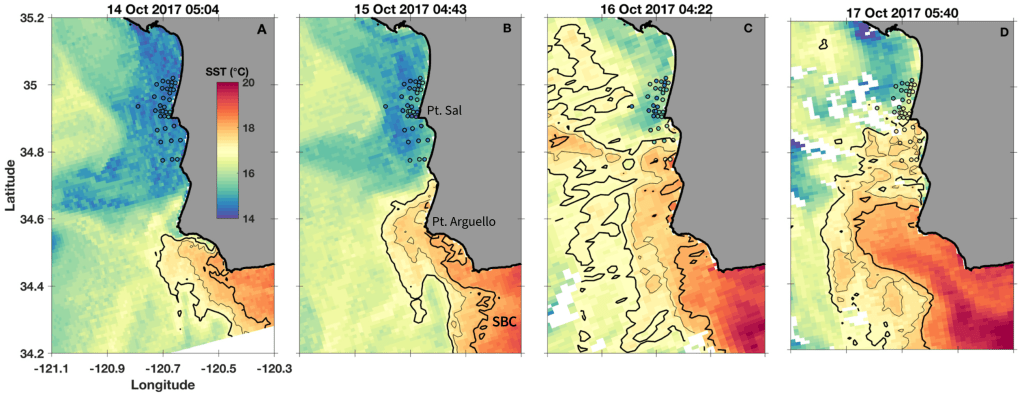
Many coastal buoyant plumes are less dense than the shelf waters because they are relatively fresh (less salty). However, coastal plumes can also be thermally driven. In central California, water in the Santa Barbara Channel is relatively warm compared to waters outside the channel and after a wind relaxation event, when typically down-coast winds slow down or reverse, these warm waters can exit the channel and propagate up-coast as a plume. This has been studied before (Washburn et al. (2011) and Suanda et al. (2016)), but we were recently able to provide new insight about the far field evolution of this plume after an array of 42 moorings captured the plume propagation in 2017!
Publication:
McSweeney, J. M., M. R. Fewings, J. A. Lerczak, and J. A. Barth. 2021. The Evolution of a Northward Propagating Buoyant Coastal Plume After a Wind Relaxation Event. J. Geophys. Res. Oceans. 126 (12). doi:10.1029/2021JC017720
 Coastal Physical Oceanography at Stony Brook