
Estuarine Temperature Variability
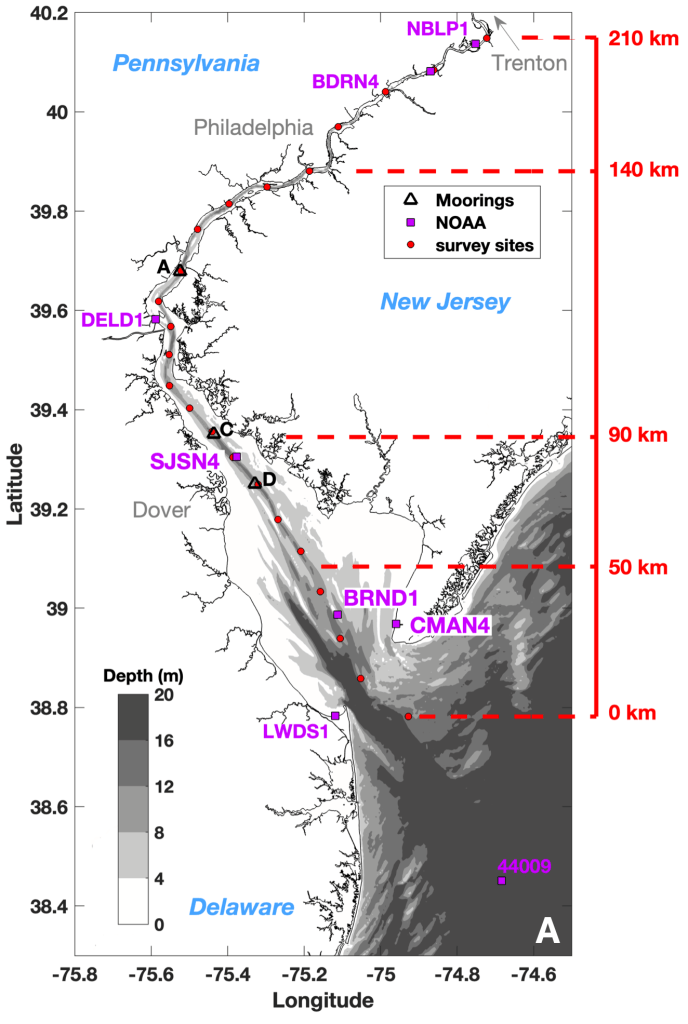
Estuaries exhibit large changes in temperature driven by atmospheric forcing, variable river and ocean inputs, and tidal mixing. The timing and magnitude of these temperature fluctuations can vary across an estuary, leading to horizontal temperature differences that evolve on timescales from hours to years. This temperature variability has important impacts on local ecosystems, such as modifying habitat and species ranges and affecting photosynthetic rates. Despite the importance of estuarine temperature variability, its patterns and drivers have not received much research attention because temperature usually has minimal impact on an estuary’s circulation.I’ve been collaborating with Melanie Fewings, Greg Gerbi, and Jim Lerczak on a project focused on temperature variability in the Delaware Estuary.
We’ve been examining the range and variability of temperatures within the Delaware Estuary using eight ~20 year records of surface temperature spaced ~20-60 km apart along the estuarine channel, as well as stationary and shipboard observations collected in 2010 and 2011 that provide finer horizontal resolution of select subregions. We’ve found that the largest temperature changes are associated with the seasonal cycle, with nearly a 30°C temperature difference between summer and winter. There is also a seasonally-reversing along-estuary temperature difference (where the ocean is cooler than up-estuary waters in the summer and warmer than up-estuary waters in winter) and a summertime mid-estuary surface temperature maximum. On timescales shorter than the seasonal cycle, temperatures can fluctuate 1-3°C due to tides and 1-6°C due to weather-related processes, river flow, and fortnightly modulation of the tides.
These findings will soon be published in Estuaries and Coasts. Stay tuned!
 Coastal Physical Oceanography at Stony Brook